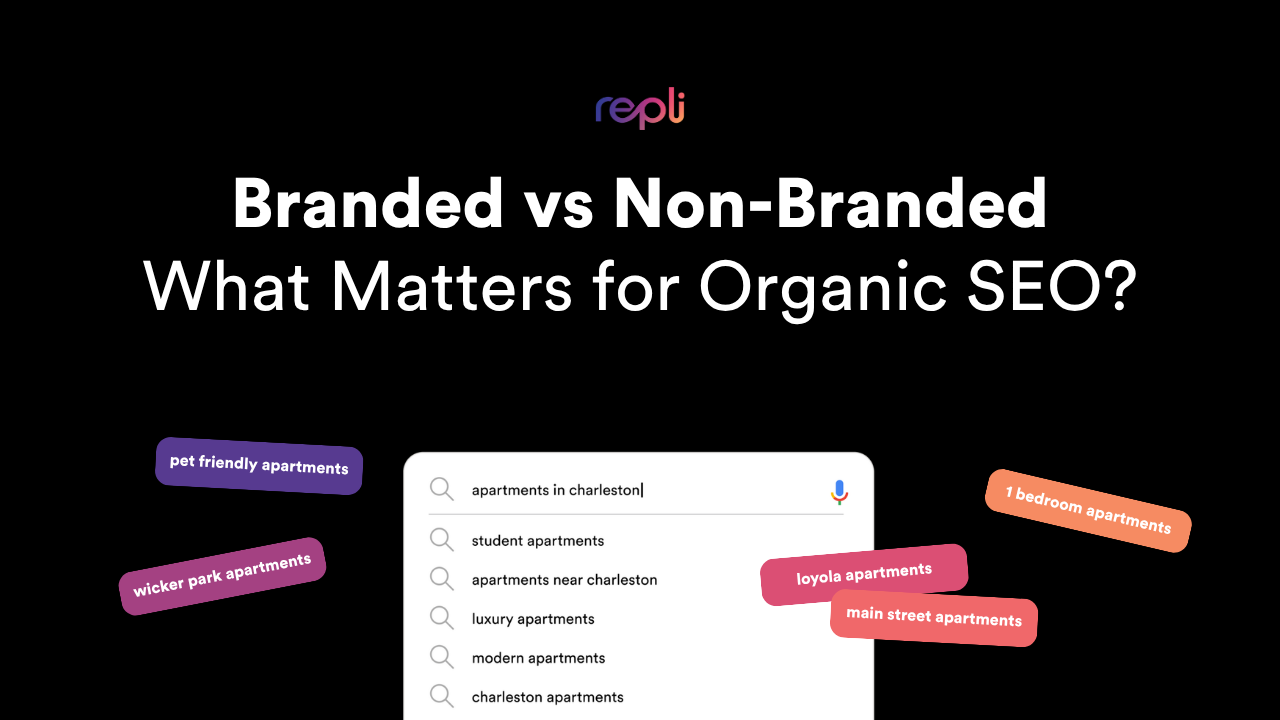
Branded vs Non-Branded Search Campaigns for Multifamily: Where Should Budget Go
After reviewing search term reports across hundreds of multifamily accounts, Repli Senior Paid Media Specialist, Tony Griego, has come to expect one thing: branded searches showing up exactly where they shouldn’t.
So let's break down why a dedicated branded campaign is less about capturing clicks and more about keeping control.
Branded Search Is More Than Brand Protection
One of the most common questions about branded search campaigns is also one of the most reasonable: "Why should I pay for people who are already looking for my property?"
It's a fair question. If someone already knows your community by name, shouldn't organic search be enough?
That's the wrong way to look at it.
The value of a branded campaign isn't simply capturing existing demand. It's controlling how that demand gets managed. Repli often recommend allocating a lean portion of a property's monthly Google Ads budget to branded search, sometimes around 10%, though the right number depends on the market and the property's goals.
On paper, it can sound like you're paying for traffic you'd have gotten anyway. In practice, that's rarely the whole story.
Branded traffic tends to be the most efficient in an account. Prospective renters already know who you are, making these searches highly relevant and often cheaper than broader apartment keywords. Low-cost conversions are one reason to use branded campaigns.
The bigger reason is control.
Your Brand Will Show Up Where You Least Expect It
Almost every month, branded searches show up in campaigns where they were never intended to go. After reviewing search term reports across hundreds of multifamily accounts, this has become the expectation, not the exception.
Here's a real example. Take a community called Kensington at The Pearl. "The Pearl" is also a well-known neighborhood in Portland, Oregon. A search like "Kensington Pearl Apartments" carries both branded intent and a geographic reference — and depending on how the account is structured, Google may route it to a neighborhood campaign instead of the branded one.
That's rarely the only variation, either.
Renters don't search in neat, predictable ways. One person searches "Kensington apartments Pearl District." Another types "The Pearl Kensington floor plans." Someone else searches "Kensington Pearl pet-friendly apartments."
Each query contains the brand name, but with different intent signals attached. Some belong in a branded campaign. Some might be better suited elsewhere. That's a decision worth making deliberately — and it's much easier when those search terms have a clear home, rather than landing wherever the algorithm happens to send them.
Individually, these variations might generate just a click or two. Collectively, they quietly spread branded traffic across campaigns that were never designed to handle it. Reporting gets murkier. Optimization gets harder. And it becomes genuinely difficult to know what's actually driving performance.
A dedicated branded campaign fixes that: one place to align messaging, control variations and bidding, and decide intentionally where searches belong.
There’s a Competitive Angle Too
Branded campaigns also defend your visibility when competitors bid on your property's name. This happens more than most people expect, and it's worth taking seriously.
A competitor showing up for a search that contains your community's name is competing for a renter who already knows you. A branded campaign keeps you front and center at one of the lowest costs in your account, and makes sure that traffic isn't quietly handed off to someone else.
Property managers will sometimes look at branded spend, see the cost, and not immediately see the complexity it's quietly solving for.
However, the structural and reporting value a branded campaign provides doesn't always show up in an obvious line item. It shows up in cleaner data, more intentional optimization, and a clearer read on what's actually driving performance.
Every property is different, and branded campaigns aren't always the right call. But the question was never really whether branded traffic is valuable; it almost always is. The real question is whether you want to manage that traffic deliberately or let it find its own way through your account.
Want to see what intentional paid ad strategy looks like in practice? See how Repli helped CWS Apartments boost leads by 97% in just 90 days → Read the case study
Repli Apartment Marketing Blog
Subscribe to our Newsletter & Blogs
Blog Post Subscribe Form
Share Our Post!
Apartment Marketing Blog