Your Renters Will Ask AI About Your Fees, Pet Policy and Parking. What Will It Say?
"Do you allow dogs over 50 pounds?"
Renters used to ask a leasing agent that question. Now they ask ChatGPT, Gemini or Google's AI Mode before they ever call you. And AI answers with confidence, whether or not it's right.
Here's the problem: the questions that decide a lease are the ones AI is most likely to get wrong. Fees, pet rules, parking and utilities change often, live in PDFs and get copied onto listing sites that never get updated.
We've already covered how to test what AI knows about your community. This post is the next step: the specific facts renters ask about, and how to make sure AI gets them right.
Renters aren't asking AI for "the best apartments." They're asking about the details.
AI is already part of the search. J Turner Research found 45.9% of renters use AI tools to search for apartments or analyze reviews (J Turner Research, July 2026).
And the questions are specific. Apartments.com analyzed conversations with its own AI search tool. Renters asked about total monthly cost including utilities and parking, move-in costs, and whether they'd qualify (Inman, Oct. 2026).
These are the facts AI needs to get right:
- Fees: What's the real monthly cost? Is there an amenity fee, trash fee, admin fee?
- Move-in costs: Deposit, application fee, first month. Is there a special right now?
- Pets: Breed and weight limits, pet rent, pet deposit, how many pets.
- Parking: Is it included? Garage or surface? EV charging? Guest parking?
- Utilities: Which are included? What does the average bill run?
- Qualifying: Income requirement, guarantors, credit and background rules.
- Lease terms: Short-term leases, month-to-month, early termination.
Why it matters: the same J Turner study found 62.3% of renters are less likely to tour after an unfavorable AI summary. A wrong answer about fees or pets isn't a small error. It's a lost tour you never knew about.
Where AI gets its answers, and why it gets them wrong.
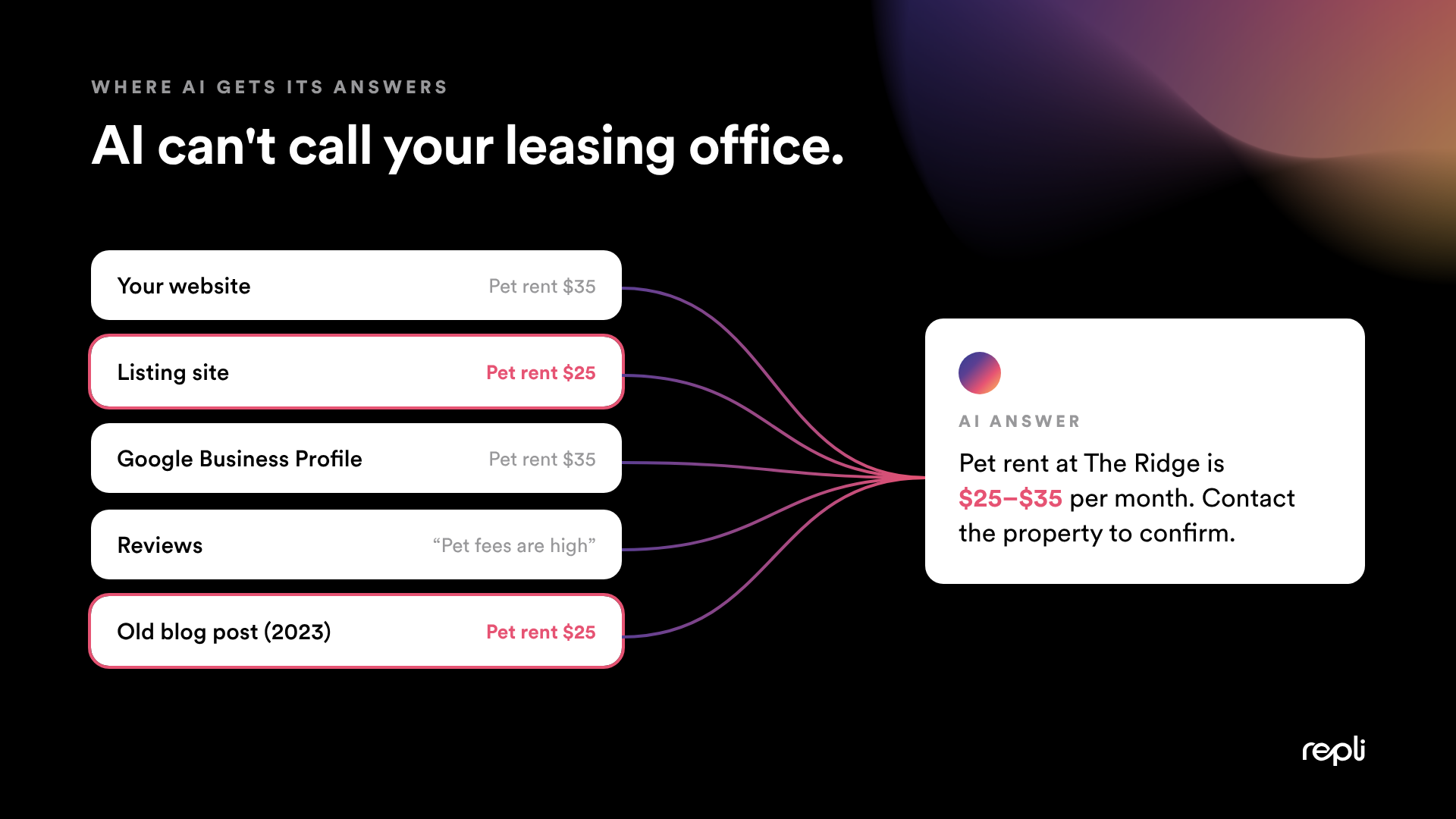
AI tools don't call your leasing office. They piece together an answer from whatever they can find: your website, listing sites, your Google Business Profile, reviews and old cached pages.
Wrong answers usually come from one of four places:
- The facts aren't on your website. If your pet policy lives in a PDF lease addendum, AI fills the gap from somewhere else.
- They're in a format AI can't read. Fees in an image, a policy behind a pop-up, pricing loaded by a script that never renders for crawlers.
- Your sources disagree. Your website says $35 pet rent. A listing site still says $25. AI picks one, or averages the confusion into something vague.
- Old information never died. A 2023 parking policy on a forgotten page or blog post still gets read and repeated.
The short version: AI can only be as accurate as the most out-of-date place your facts appear.
Test it: ask AI the questions your renters ask.
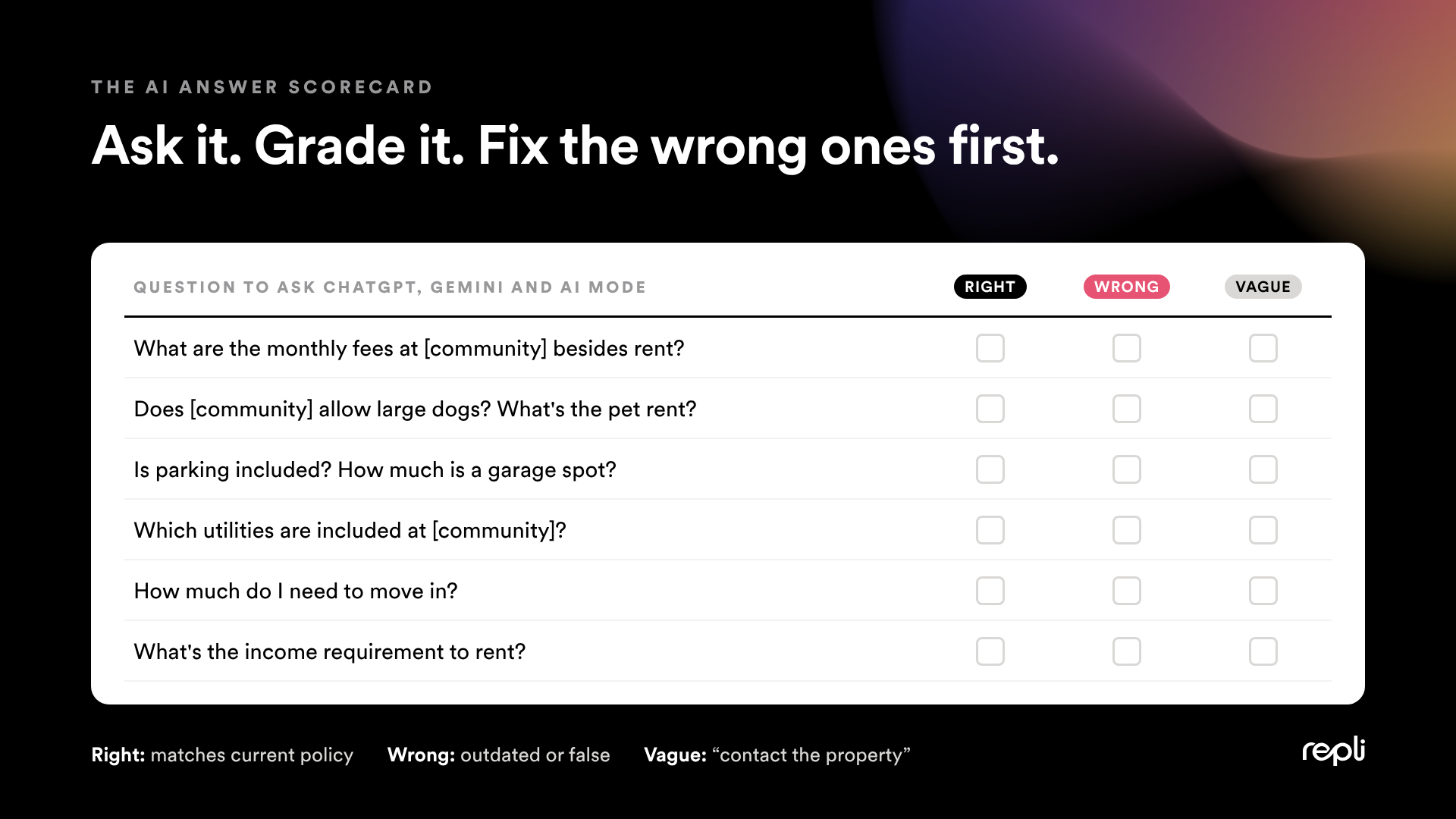
Open ChatGPT, Gemini and Google's AI Mode. Ask each one the questions below, using your community's name and city. Write down every answer.
- "What are the monthly fees at [community] in [city] besides rent?"
- "Does [community] allow large dogs? What's the pet rent?"
- "Is parking included at [community]? How much is a garage spot?"
- "Which utilities are included at [community]?"
- "How much do I need to move in at [community]?"
- "What's the income requirement to rent at [community]?"
Then grade each answer:
- Right: matches your current policy.
- Wrong: states something outdated or false.
- Vague: "Contact the property for details." That means AI couldn't find it.
Vague answers are an opening. Wrong answers are a problem. Fix wrong answers first.
Fix it: make your website the source AI trusts.
1. Put every fact on a real web page.
Not a PDF. Not an image. Not a pop-up. Give fees, pets, parking and utilities their own clearly labeled sections in plain text, on a page that loads without a click.
2. Show the total, not just the rent.
List every recurring fee by name and amount: amenity, trash, pest, technology, parking, pet rent. Then show what a typical month adds up to. Renters are asking AI for the total. Give it one to find.
3. Write policies the way renters ask about them.
"Pets welcome" answers nothing. "Up to two pets, 75 lb combined limit, $35/month pet rent per pet, $300 one-time fee" answers everything. Specific beats friendly.
4. Add an FAQ that uses renters' own words.
Turn the questions from your test into on-page FAQs: "Is parking included?" "Can I have a large dog?" Short, direct answers. One fact per answer.
5. Use structured data.
Mark up your community as an apartment complex with address, phone, amenities and pet policy. Structured data tells machines what each fact is, not just what the page says. (More on that here.)
6. Make every source agree.
Update listing sites, your Google Business Profile and social bios to match your website. Then delete or update old pages and blog posts with outdated policies. One fact, one version, everywhere.
7. Re-test every quarter.
Policies change. Fees change. Run the same questions again and track what moved from wrong to right.
Where VibeSites fits.
The hardest part of this list is #6: keeping every fact the same everywhere. That's why we built VibeSites on one record. Every multifamily website pulls from the same MultiHub property profile, so a change made once shows up on the next publish. Pricing, availability, specials and tour times stay current without republishing.
Every VibeSite also ships with multifamily schema and an llms.txt file, and pages are prerendered static HTML that AI crawlers can read.
Want to see what AI says about your communities, and what to fix first?
Let's talk.

ABOUT THE AUTHOR
Siobhan is the VP of Marketing & Training at Repli. With over 10 years of digital marketing experience, Siobhan is dedicated to pushing boundaries and disrupting the industry by sharing insights on trends, technology, and best practices to help multifamily marketers thrive. When she's not creating content, she's often traveling with her family, filming k-pop dance covers, or exploring her favorite restaurants.
Repli Apartment Marketing Blog
Subscribe to our Newsletter & Blogs
Blog Post Subscribe Form
Share Our Post!
Apartment Marketing Blog