How Long Does SEO Take? Google's Timeline vs. AI Search
"How long until we see results?"
Every property marketer has asked it. Every SEO has answered with some version of "it depends." Now Google has given us real numbers.
On October 2, 2026, Google's Gary Illyes walked the room at Search Central Live Deep Dive in Barcelona through Google's internal timing data: how long it typically takes to crawl, index, and serve changes in Search. [1]
We rebuilt that data below, then put it next to the newest research on how fast AI search tools surface content. The short version: AI search isn't a shortcut around SEO. It runs on top of it.
First, where these numbers come from.
Context matters here, because this data will change.
- The timings came from Illyes's slides, recapped by attendees and SEO press. [1] [2] Google hasn't published them as official documentation.
- Google described them as based on its internal analysis. No sample size or date range was shared.
- Illyes called the slides "an exercise to see if the audience can relate to the numbers." [2]
Treat them as typical ranges, not guarantees.
Here's how long Google says SEO takes.
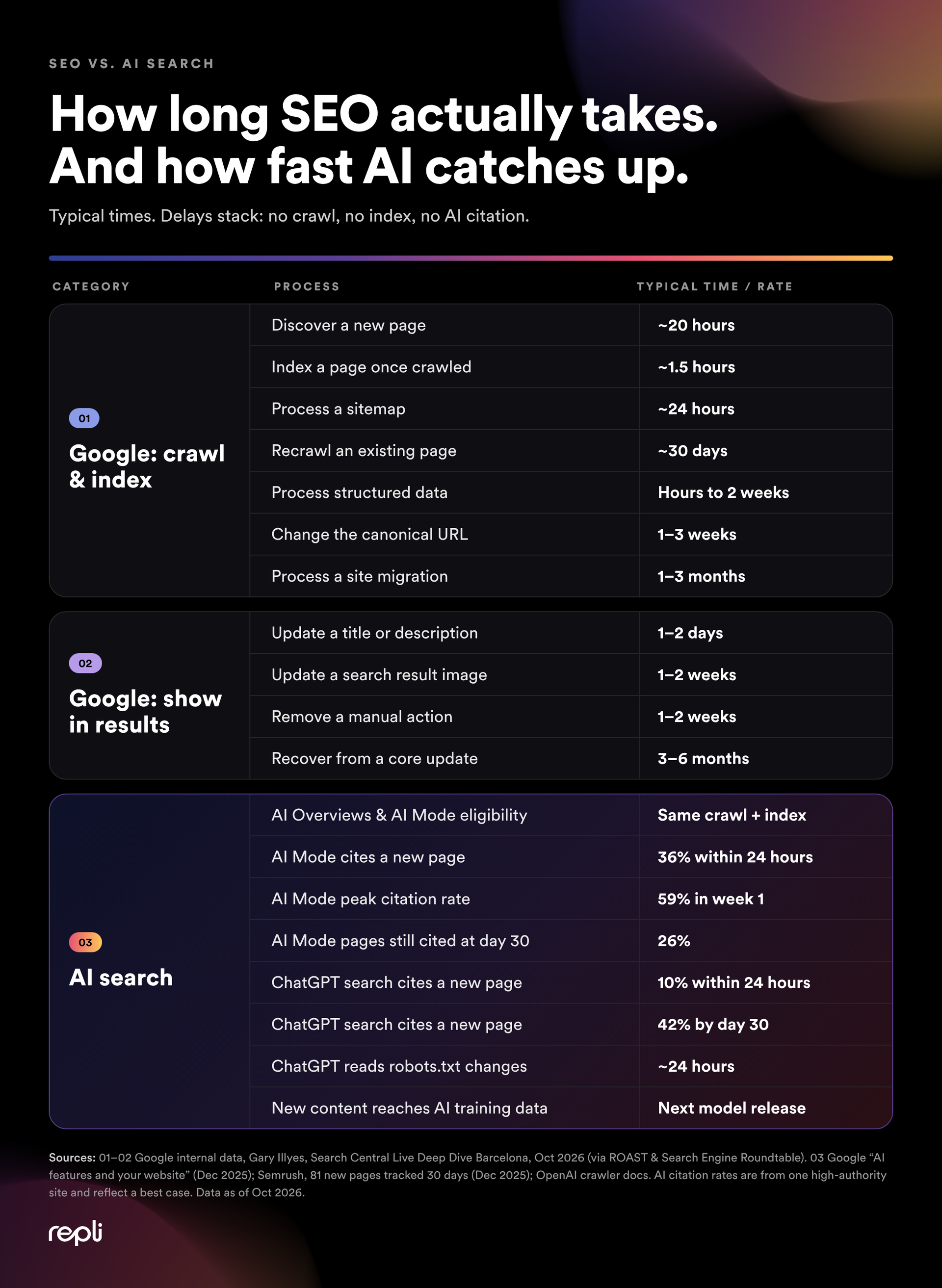
A few rows matter more for apartment websites than others.
New pages get found fast. Old pages get revisited slowly. Google typically discovers a new URL in about 20 hours, and indexing itself takes about 1.5 hours once a page is crawled. But a known page gets recrawled roughly every 30 days. [1] That's an average across the web, and important pages get crawled more often. But if you change a specials page or floor plan pricing and expect search to reflect it tomorrow, it may not.
Title and description changes take 1–2 days. That's a quick win when a property rebrands or a lease-up turns into a stabilized community.
Structured data can take hours to two weeks. Schema isn't instant. Give it time before you decide it isn't working.
Site migrations take 1–3 months. The slowest cases run six months to a year or longer. [1] If you're switching website providers or consolidating property domains, plan the runway before you sign.
Core update recovery takes 3–6 months. In the worst cases, a site waits for the next core update. [1] There's no quick fix after a hit.
And one more thing: these delays stack. A page can't be indexed until it's crawled, and it can't rank until it's indexed. [1]
AI search runs on the same pipes.
This is the part most "AI optimization" pitches skip.
At the same event, Illyes said: "AI features in Google Search use exactly the same processes as traditional results" and "AI results are built on SEO infrastructure." [2]
Google's own documentation agrees. To show up as a link in AI Overviews or AI Mode, a page has to be "indexed and eligible to be shown in Google Search with a snippet." Google adds: "There are no additional technical requirements." [3]
So every timeline in that chart applies to Google's AI results too. If Google hasn't crawled your updated page, AI Overviews can't cite it.
AI can cite new pages fast, but not reliably.
Semrush ran a controlled test: 81 new pages, published on its own blog, tracked daily for 30 days in Google AI Mode and ChatGPT search. [4]
- Google AI Mode cited 36% of the new pages within 24 hours and peaked at 59% within the first week. Then citations dropped. By day 30, only 26% were still cited.
- ChatGPT search started slower: 10% within 24 hours, 17% at day 7, and 35% at day 14. By day 30 it had reached 42%, and pages it cited mostly stayed cited.
- Many pages were never cited at all during the 30 days.
Two caveats. The Semrush blog has high domain authority, so the authors called this close to a best-case scenario. And the test covered only two platforms. [4] A single apartment community's website shouldn't expect the same speed.
Still, the pattern is useful. Google's AI picks things up fast and keeps re-checking its sources. ChatGPT is slower but stickier.
Fresh content gets cited more, but freshness isn't everything.
Ahrefs analyzed nearly 17 million AI citations. Content cited by AI assistants was, on average, 25.7% fresher than content in Google's organic results. [5]
But "fresher" is relative. The average cited page was still about 2.9 years old. Google AI Overviews actually cited slightly older content than organic results did. [5]
Takeaway: keeping key pages updated helps. Publishing new pages just to look new doesn't.
Live AI search is different from what a model already knows.
There are two ways AI tools learn about your property.
Live search. ChatGPT search, AI Mode, and similar tools fetch pages when someone asks a question. OpenAI uses a crawler called OAI-SearchBot to surface sites in ChatGPT search, and says robots.txt changes take about 24 hours to reach its search systems. [6] This is where the timelines above apply.
Training data. What a model "knows" without searching comes from data collected before it was trained. New content doesn't reach that layer until a future model ships. There's no timeline for that, and no way to speed it up.
For leasing, live search is the layer that matters. It's the one that can see today's pricing, specials, and availability, as long as it can crawl and index your site.
What this means for property websites.
- Don't judge a page in a week. Give new pages two to four weeks before deciding they're not performing. Give technical changes like schema or canonicals one to three weeks.
- Crawlability is now an AI requirement. If Google can't crawl and index a page, it can't appear in AI Overviews or AI Mode. Technical SEO is the entry fee for AI visibility.
- Keep sitemaps clean and current. Google typically processes a sitemap in about 24 hours. [1] Accurate sitemaps help Google find what changed instead of waiting for the next recrawl.
- Use faster channels for time-sensitive offers. A move-in special that runs for two weeks might not get recrawled in time. Pair it with Google Business Profile posts and paid search.
- Plan migrations like construction projects. One to three months for Google to process a site move is the typical case. Don't launch a new site the week before peak leasing season.
- Set expectations with owners. "SEO takes time" now has Google's own numbers behind it.
SEO and AI search are one strategy now.
The fastest way to show up in AI search is still the slow, steady work of good SEO: crawlable pages, clean structure, accurate content, and patience.
VibeSites are built for AI search from the ground up, and Repli's SEO team builds on that foundation so your properties get found, crawled, and cited. Ready to see what that looks like for your portfolio? Let's talk.
ABOUT THE AUTHOR
Siobhan is the VP of Marketing & Training at Repli. With over 10 years of digital marketing experience, Siobhan is dedicated to pushing boundaries and disrupting the industry by sharing insights on trends, technology, and best practices to help multifamily marketers thrive. When she's not creating content, she's often traveling with her family, filming k-pop dance covers, or exploring her favorite restaurants.
Sources
- John Campbell, "Google Search Central Live Deep Dive Barcelona: Day 3 Recap," ROAST, Oct 2, 2026. https://weareroast.com/news/google-search-central-live-deep-dive-barcelona-day-3-recap/
- Barry Schwartz, "Google Search Data On Crawling, Indexing & Serving Timelines," Search Engine Roundtable, Oct 5, 2026. https://www.seroundtable.com/google-crawling-indexing-serving-data-42225.html
- Google Search Central, "AI features and your website," last updated Dec 10, 2025. https://developers.google.com/search/docs/appearance/ai-features
- Tushar Pol, "How Fast Do AI Search Platforms Cite New Content?," Semrush, Dec 10, 2025. https://www.semrush.com/blog/how-fast-do-ai-search-platforms-cite-new-content/
- Ryan Law and Xibeijia Guan, "New Study: AI Assistants Prefer to Cite 'Fresher' Content (17 Million Citations Analyzed)," Ahrefs, July 28, 2025. https://ahrefs.com/blog/do-ai-assistants-prefer-to-cite-fresh-content/
- OpenAI, "Overview of OpenAI Crawlers." https://developers.openai.com/docs/bots
Data current as of October 22, 2026. Google and AI platform timelines change often; we'll update this post as new data is published.
Repli Apartment Marketing Blog
Subscribe to our Newsletter & Blogs
Blog Post Subscribe Form
Share Our Post!
Apartment Marketing Blog