Google's AI Search Guide: What It Means for Your Property
Google publishes guidance documents pretty regularly. Algorithm updates, quality rater guidelines, structured data documentation — it's a steady drumbeat of "here's what we want from your website." So when the Google dropped its official guide on optimizing for generative AI features, it wasn't exactly a landmark event.
What was interesting was the reaction.
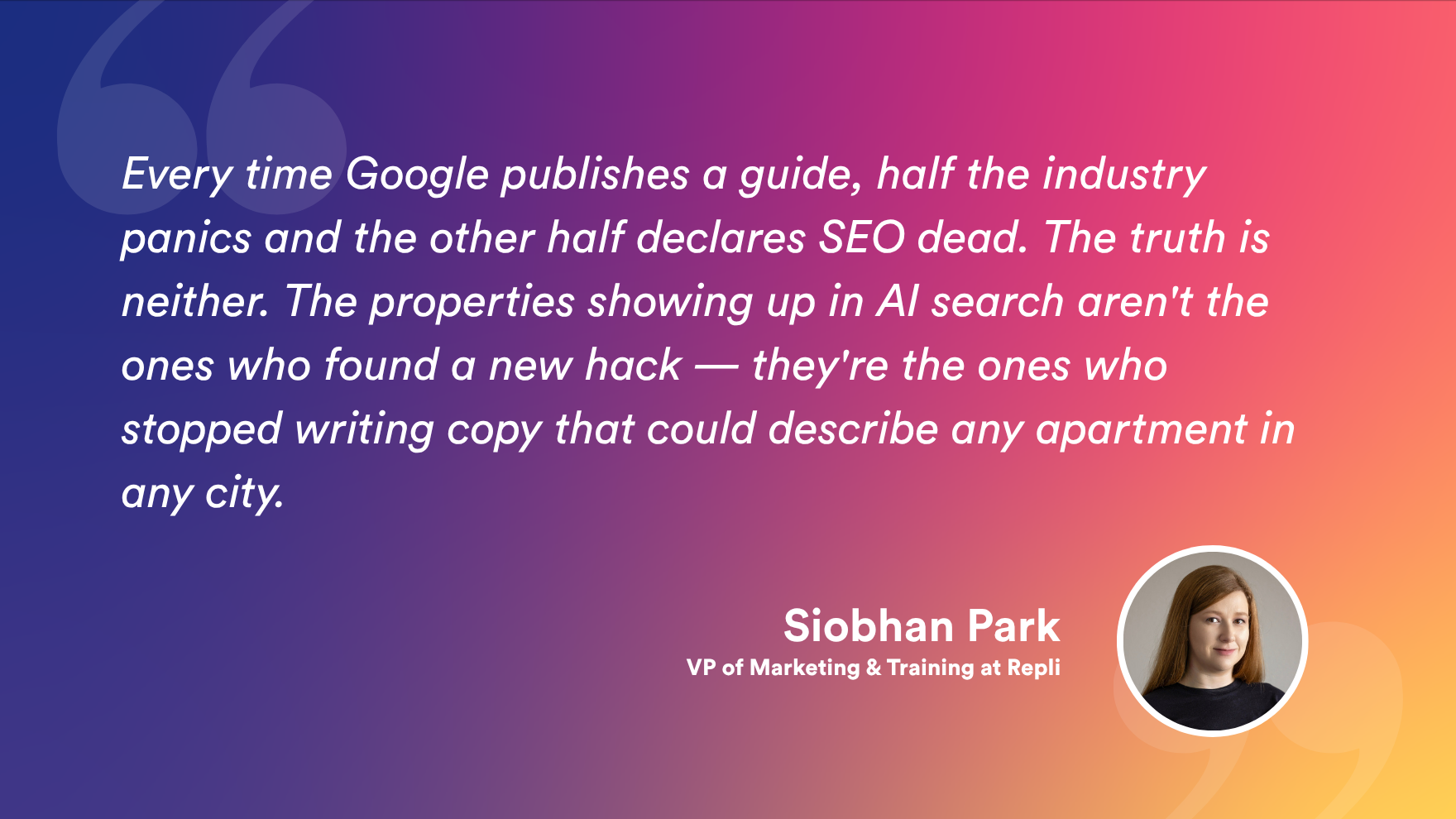
The SEO community went loud — and largely split. Half the industry declared AEO and GEO dead. The other half said the guide completely missed the point, because it only talks about Google's AI surfaces and ignores ChatGPT, Perplexity, Claude, and every other AI tool your future renter is probably using right now.
Both camps have a point. Neither camp is telling you what to do.
So let's do that instead.
What Google's Guide Actually Says (And What It Doesn't)
Google's AI optimization guide is primarily about one thing: how to show up in AI Overviews and AI Mode on Google Search. Not ChatGPT. Not Perplexity. Not the AI assistant your renter used at 10pm to ask "what are the best pet-friendly apartments near downtown with a big dog run." Just Google's own surfaces.
That's a real and important limitation — and the critics calling it out aren't wrong. If your prospective renter is using multiple AI tools to research apartments (and they are), a guide that only addresses Google's AI is telling you maybe 40% of the story.
That said, what Google did validate is worth paying attention to. Because it's the same stuff that works everywhere else, too.
- Specific, non-generic content wins. Google's own example in the guide contrasts two approaches: a "7 Tips for First Time Homebuyers" style article (commodity, forgettable) versus a piece about a specific, firsthand experience with genuine detail. The non-commodity content wins every time. For apartment marketing, this is the difference between "resort-style amenities" and actually describing what it feels like to use them.
- Firsthand experience and original expertise matter. AI systems — Google's and everyone else's — are increasingly good at identifying content that only a real person with real knowledge could have written. Generic copy that could describe any apartment in any city is exactly what they're learning to deprioritize.
- Authentic mentions across the web carry weight. Reviews, local blog coverage, neighborhood mentions — these create the kind of distributed signal that tells AI systems your property is real, trusted, and worth recommending. Manufactured mentions are explicitly called out as not working.
- Technical fundamentals still matter. Crawlable pages, fast load times, mobile performance, clean sitemaps. This isn't new. But the stakes are higher now — if Google can't crawl it, Google's AI can't cite it.
Where the Guide Falls Short (And Why It Matters for You)
Here's what Google's guide doesn't answer, and what the critics are right to flag.
It's silent on every AI surface that isn't Google. When a renter opens ChatGPT and types "best apartments near Midtown Atlanta under $2,000 with in-unit laundry," your property's visibility in that answer depends on signals Google didn't even mention. Things like how your content is structured for AI extraction, whether you have an llms.txt file, how well your schema helps non-Google AI systems understand what you offer.
Google's guide basically says: for our surface, these things don't matter. What it doesn't say — and can't say — is that they don't matter for anyone else's surface.
The practical implication for multifamily marketers: don't let Google's guide set the ceiling for your AI visibility strategy. It describes the minimum floor. Properties that want to show up across the full landscape of how renters are searching today need to think broader than one company's documentation.
The Multifamily Translation: What to Actually Do
Regardless of which AI surface you're optimizing for, the same core problems on most property websites are hurting you everywhere. Here's where to focus.
- Kill the commodity copy. "Modern finishes. Spacious layouts. Unbeatable location." This language is invisible to AI systems because it's indistinguishable from thousands of other properties saying the exact same thing. Your amenity pages, neighborhood content, and community story need specificity. Not "dog-friendly community" — describe the dog park. Not "convenient location" — name the coffee shop, the transit stop, the Saturday morning farmers market two blocks away.
- Write for humans. The AI will figure it out. One thing Google's guide is right about: don't rewrite your content in some special "AI voice" or artificially restructure it for machine consumption. Write clearly for prospective renters asking real questions. Use headers. Front-load answers. Be direct. That structure serves human readers and AI extraction equally.
- Your reviews are doing SEO work whether you know it or not. AI Overviews and other AI tools synthesize review language when building answers about local businesses. A review that says "maintenance fixed my dishwasher in four hours and the leasing team knew my name by the second visit" is actively training AI systems on what to say about your property. That's not an accident — it's the signal working as designed. Responding to reviews with specific, property-relevant language reinforces it further.
- Solid technical foundations are non-negotiable. Fast pages. Clean crawl. Mobile performance. Proper indexing. These aren't nice-to-haves — they're the ticket to being found by any AI system at all. If your site has technical debt, that debt is now costing you AI visibility across every platform, not just Google rankings.
- Schema markup is still worth doing. Google says it's not required for AI Overviews. That's true for Google's surface. On other AI platforms, structured data still correlates with how accurately AI systems extract and cite your content. Use local business schema, review schema, and FAQ schema. Not as a shortcut — as infrastructure.
Our Honest Take
Google's AI guide isn't a revolution. It's Google describing what Google rewards on Google's surfaces — which, to be fair, is genuinely useful information, just incomplete.
The properties that will win across the full AI search landscape in 2026 are the ones that don't wait for any single company to publish a guide before deciding what matters. They're the ones building real, specific, trustworthy content about real, specific communities — and making sure that content is technically accessible to every system trying to read it.
That's not a new strategy. It's the one that's always worked. The AI era just makes the gap between properties doing it and properties not doing it impossible to ignore.
Want to know where your properties stand?
Talk to our team about content audits, technical SEO, and the AI visibility gaps that most property websites don't even know they have.
Repli Apartment Marketing Blog
Subscribe to our Newsletter & Blogs
Blog Post Subscribe Form
Share Our Post!
Apartment Marketing Blog