ChatGPT Ads Are Open for Business. Multifamily Isn't Ready to Buy In.
OpenAI started running ads in ChatGPT in early 2026, and the multifamily industry has mostly responded with one of two reactions: breathless excitement or a wait-and-see shrug.
Neither is the right call.
ChatGPT Ads are real, they're live, and the barrier to entry is lower than you'd expect. But before you reallocate budget, you need to understand what the platform actually is — and what it isn't — because most multifamily ad strategies run on a tight, performance-accountable logic that ChatGPT Ads cannot reliably support yet.
Here's the honest picture after getting inside the platform.
First: understand what you're actually looking at.
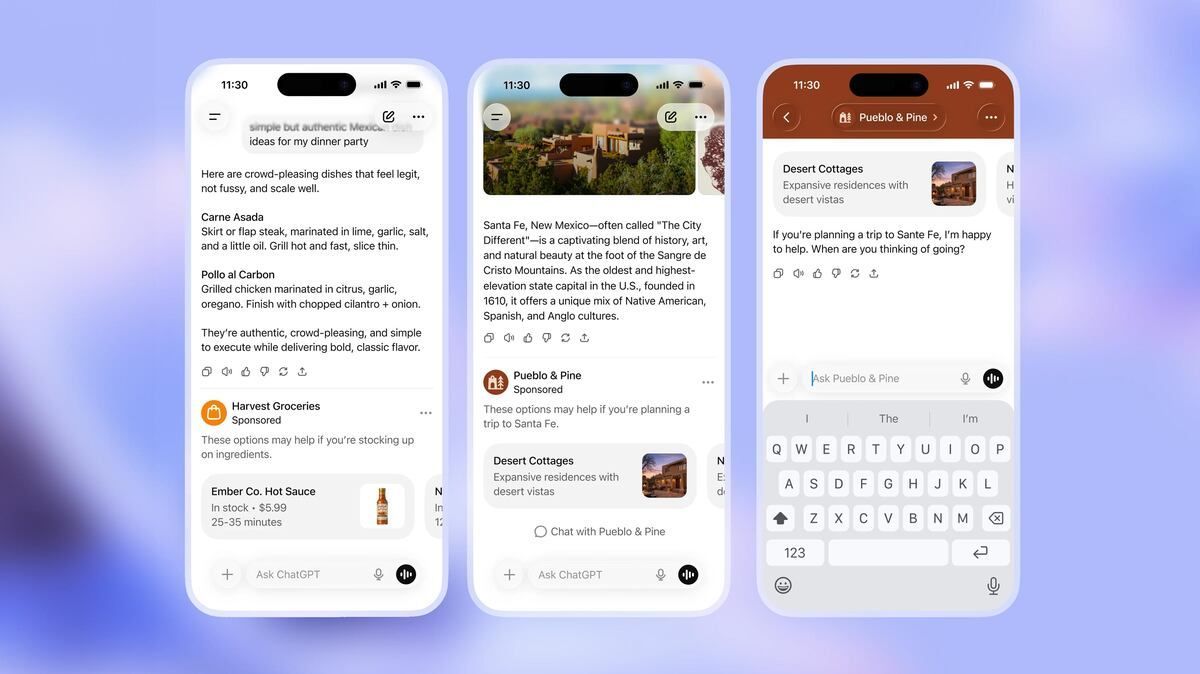
ChatGPT Ads appear as labeled "Sponsored" placements — a clearly marked box that sits below the AI's organic response. They don't change what ChatGPT recommends in the answer itself. The AI's organic response is still earned, not bought.
That distinction matters for multifamily. If a renter asks ChatGPT "best apartments near downtown Austin under $1,500," the communities that appear in the answer got there through content authority and AEO optimization — not paid placement. The sponsored box is a separate, secondary layer.
Also worth knowing: only free-tier ChatGPT users see ads at all. Paid subscribers don't. That limits your reach, at least for now.
How it compares to Google Ads and where the gaps are.
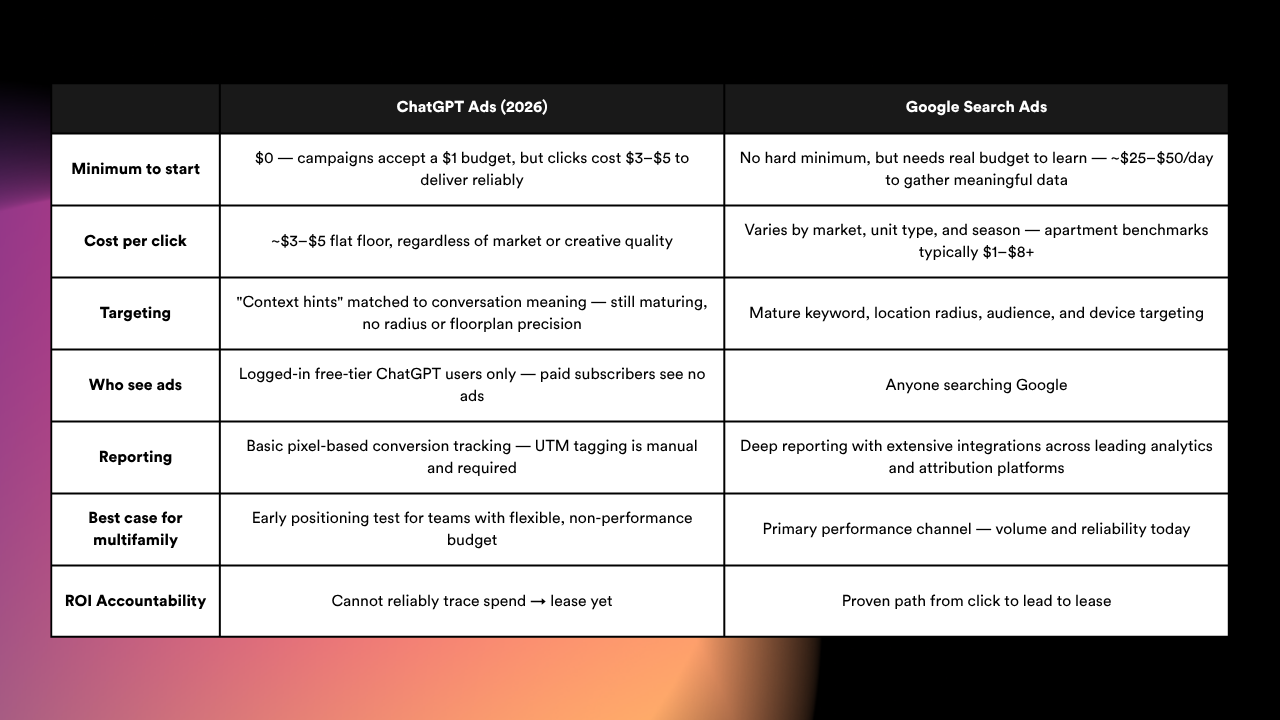
Google Ads is a mature, data-rich auction system built over 25 years. ChatGPT Ads is, by any honest measure, where Google was at launch: minimal, flat-priced, and still learning.
The structural differences that matter most for multifamily:
Keywords vs. context hints.
Google matches ads to keyword intent. ChatGPT uses "context hints" — short thematic descriptions you provide that tell the platform which conversations your community is relevant to. The platform matches those hints to the meaning of a conversation, not an exact search term. It's a softer signal, and early reads suggest narrow, specific hints outperform broad ones. "Pet-friendly apartments near midtown Atlanta" will perform better than "apartments."
Bidding.
Google CPC benchmarks for apartment ads are deeply segmented by market, unit type, and season — the product of years of auction data. ChatGPT's system is a flat floor: the platform recommends a max CPC of $3–$5, and below $3 your ads likely won't deliver at all. That $3 threshold isn't based on your market or your creative quality. It applies to everyone equally. The nuance you're used to in Google simply doesn't exist here yet.
Geotargeting.
Google lets you draw a radius around your community's address. ChatGPT Ads supports state, DMA, and ZIP-level targeting — an improvement over its country-only launch, but still no radius option. For a community trying to reach renters within a realistic commute, you're left choosing between a DMA that may cover half a metro or a manually assembled ZIP list. Workable for a test; not precise enough to anchor a strategy.
Floorplan-level targeting.
This is the biggest gap for multifamily. Google's keyword structure maps reasonably well to unit type and vacancy. In ChatGPT, if you build campaigns for studios, one-bedrooms, and two-bedrooms separately, your context hints will overlap and the platform will struggle to differentiate. The most workable structure for now: one community-level campaign with ad groups split by bedroom count, each with distinct context hints. Expect less precision than you're used to.
The operational pieces you need before you launch.
1. Account Ownership
ChatGPT Ads requires an EIN to open an account — the property management company or ownership group creates the account first, then grants agency access. Unlike most ad platforms, your agency can't set this up on your behalf from the start.
2. Attribution Is Manual
Untagged ChatGPT traffic lands in Google Analytics as a generic referral. You need UTM parameters on every destination URL in setup, and we'd recommend pulling AI traffic into its own channel group so paid and organic ChatGPT traffic are measured separately. This is table stakes. Without it, you won't know what's working.
Our honest recommendation for most multifamily marketers: not yet.
Multifamily ad budgets live and die by a clear chain of accountability: spend goes in, leads come out, leases get signed. That's the standard your Google campaigns are held to, and it's the right standard.
ChatGPT Ads can't reliably deliver that chain right now. Delivery is thin, floorplan targeting is imprecise, attribution requires manual work, and there's no proven benchmark for what a lease-attributable ChatGPT click actually costs in this industry. For communities where every dollar needs a traceable return, this isn't the place to deploy meaningful budget.
If your paid advertising strategy has slack, a test-and-learn budget that doesn't need to justify itself with a signed lease this quarter, then a small, time-limited ChatGPT campaign is a reasonable experiment. The daily minimums are low (around $25), competition is genuinely thin right now, and the institutional knowledge you build today will matter as the platform matures and the rest of the industry catches up.
But let's be clear about what that is: a learning investment, not a performance channel. Don't let early enthusiasm move the budget away from Google campaigns that are already driving qualified traffic.
The thing that actually moves the needle in ChatGPT: organic optimization.
Here's the part that often gets buried in ads coverage: the sponsored box sits below the AI's response. The organic recommendation is the response. Getting your community named inside ChatGPT's answer when a renter asks about apartments in your market is an AEO challenge, not an advertising one.
That's where the longer-term work is. Structured content, conversational FAQs, clear schema markup, and well-organized property information are what give AI models enough signal to surface your community in organic answers. The ad buys visibility around the answer. Organic optimization earns placement inside it.
If you're deciding between investing in ChatGPT Ads and investing in AEO-ready content for your property websites, the content wins right now — with or without the paid layer on top.
Want to understand where ChatGPT Ads fit into your broader digital strategy — and whether your property websites are built to show up organically in AI search?
ABOUT THE AUTHOR
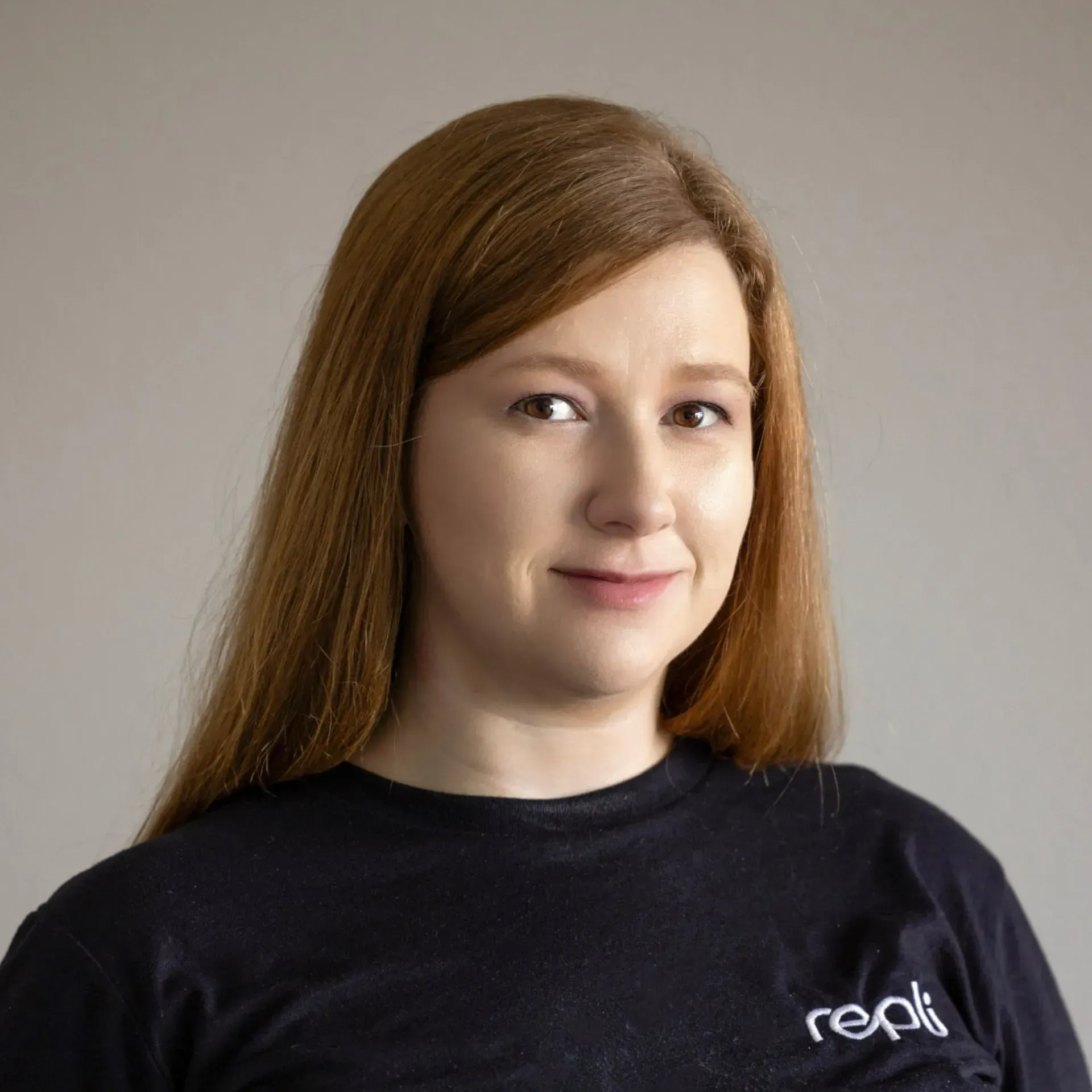
Siobhan is the VP of Marketing & Training at Repli. With over 10 years of digital marketing experience, Siobhan is dedicated to pushing boundaries and disrupting the industry by sharing insights on trends, technology, and best practices to help multifamily marketers thrive. When she's not creating content, she's often traveling with her family, filming k-pop dance covers, or exploring her favorite restaurants.
Repli Apartment Marketing Blog
Subscribe to our Newsletter & Blogs
Blog Post Subscribe Form
Share Our Post!
Apartment Marketing Blog