More Traffic Doesn’t Mean Better Rankings
This is a subtitle for your new post
Every spring, leasing season kicks into gear and your traffic numbers start climbing.
More searches. More clicks. More competition.
So if the numbers are going up, you’re winning right?
Not exactly.
Here’s something a lot of property managers don’t realize: more traffic does not automatically mean better rankings. Google isn’t just counting clicks. It’s watching what happens after the click.
That’s where engagement comes in. And during leasing season, it’s one of the most underestimated factors in your entire SEO strategy.
What Does Google Actually See?
Think about the last time you Googled something and clicked a result, only to leave immediately because the page wasn’t what you expected. You went right back to Google and tried the next one.
Google noticed that. And it remembers.
Now apply that to your property. Let’s say two communities are ranking side by side.
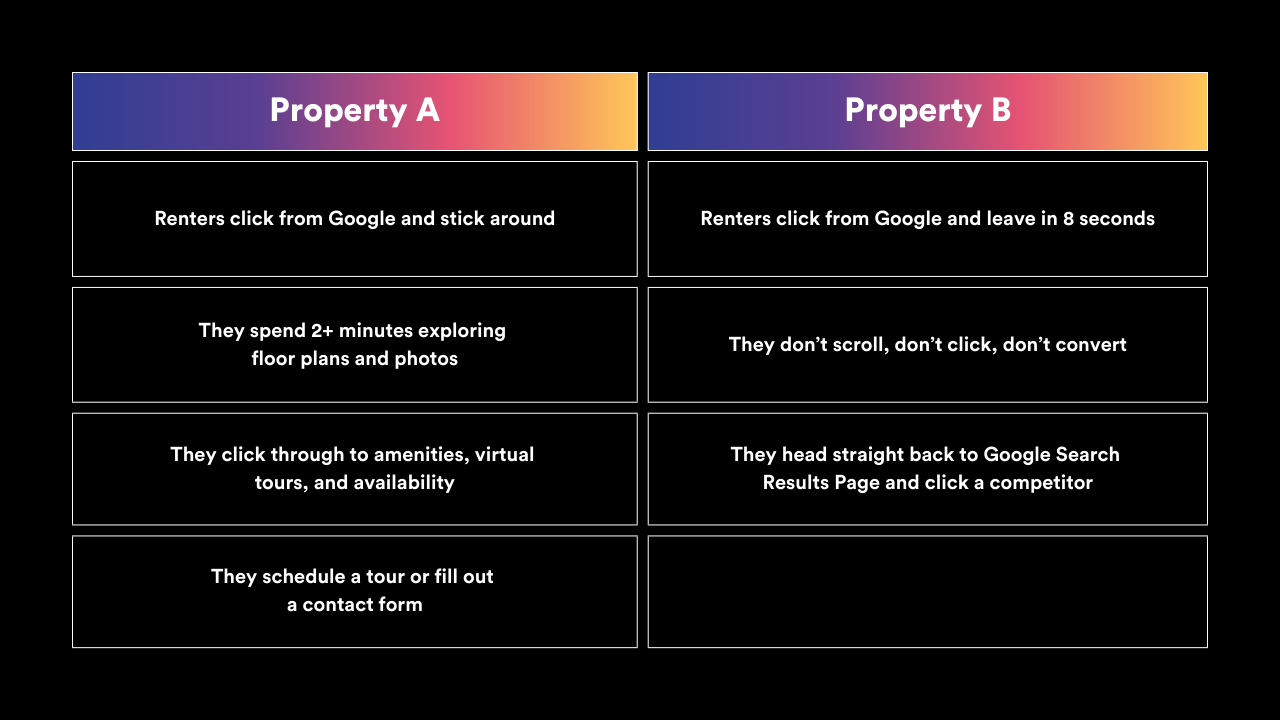
Both might start on page one. But over time, Google picks up on the pattern. Which result kept people engaged? Which one sent them running? That back-and-forth behavior even has a name: pogo-sticking. And it’s a signal Google takes seriously.
The property that earns the stay, earns the ranking.
The Engagement Signals That Move the Needle
While Google doesn’t hand over a checklist, the SEO community has a pretty good read on the behaviors that matter most.
DWELL TIME
How long does someone stay on your page before going back to search results? The longer they stay, the more Google trusts that your content is worth finding.
BOUNCE RATE
A quick exit is one thing. A quick exit followed by a click on your competitor is another. That pattern tells Google your page didn’t deliver.
PAGES PER SESSION
When a renter digs into your floor plans, checks your pet policy, and reads about the neighborhood, that’s a win. Multiple page visits signal a genuinely interested user, and Google sees it.
CLICK-THROUGH-RATE (CTR)
If your listing keeps showing up in search but people keep skipping it, that’s a problem. Your title tag and meta description are your first impression. Make them count.
What You Can Do About It
You can’t control how many people are searching for apartments in your market. But you have a lot of control over what they find when they get to your site.
Ask yourself a few honest questions:
Does your site load in under 3 seconds?
If not, you’re losing people before they even see your property.
Are your floor plans easy to find and actually worth browsing once someone gets there?
Is your pricing and availability up to date?
Stale information is one of the fastest ways to lose a renter’s trust.
Are “Schedule a Tour” and “Check Availability” easy to find on every page?
If a renter has to hunt for next steps, they won’t.
Is your site built for mobile?
More than 60% of apartment searches happen on a phone. A clunky mobile experience will cost you.
When you build a better experience for renters, you’re sending better signals to Google too.
Leasing season is going to bring you traffic whether you’re ready or not. The question is what that traffic does once it arrives.
Rankings follow relevance. Relevance is proven by behavior. And behavior is shaped by the experience renters have the moment they land on your site.
If your numbers spike every spring but your rankings don’t hold, engagement is where the gap is. And more ads won’t fix it – a better website will.
So don't just compete for the click; compete for what happens after it.

ABOUT THE AUTHOR
Jamie is a Senior Organic Media Specialist at Repli, where he helps multifamily properties turn clicks into conversions. With a background spanning eCommerce, Web Development, and SEO, he specializes in building organic strategies that do more than rank. From improving site performance to increasing conversions, he delivers measurable results for the audiences that matter most. When he’s not optimizing, you’ll find him at the beach, on a hiking trail, or chasing the next adventure.
Repli Apartment Marketing Blog
Subscribe to our Newsletter & Blogs
Blog Post Subscribe Form
Share Our Post!
Apartment Marketing Blog