The Difference Between Using AI... and Actually Being Good At It
The 4D Framework for AI Fluency
Using AI is one thing. Knowing how to work with it is another.
Let's be honest for a second...
Most multifamily marketers are already using AI.
But very few are actually good at it.
But, if we're being real, it still feels a little inconsistent.
Sometimes it's helpful.
Sometimes it's generic.
Sometimes it just... misses the point.
And that's not an AI problem.
It's a how you're using it problem.
That's where this framework comes into play.
The 4D Framework for AI Fluency breaks down what actually makes someone good at working with AI, not just using it casually.
It comes down to four main things:
→ Delegation
→ Description
→ Discernment
→ Diligence
And once you start thinking this way, AI stops feeling random... and starts feeling useful.
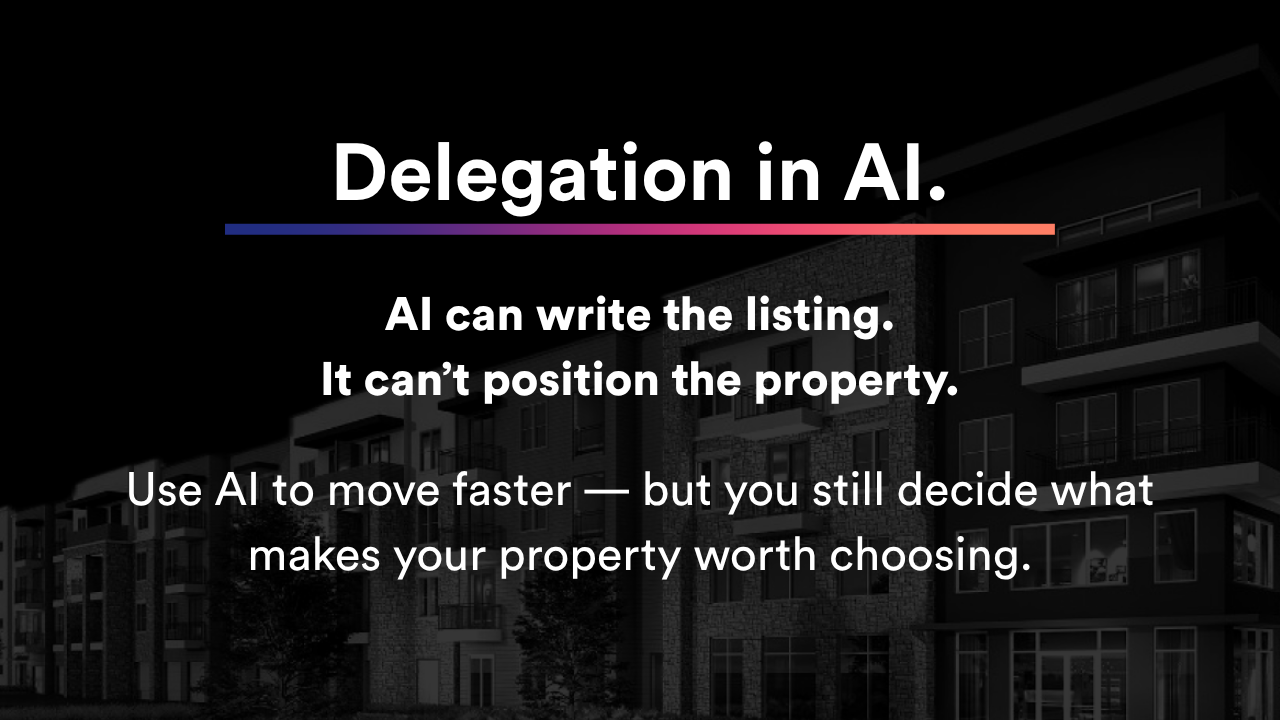
What AI should do — and what you shouldn’t give it?
1. Delegation
AI is great at speed.
It can write, summarize, analyze, and generate ideas... very FAST.
But in multifamily marketing, not everything should be automated.
For example:
✅ AI can draft apartment descriptions, social captions, or email campaigns
✅ AI can summarize renter reviews or identify common themes
❌ AI shouldn’t decide your positioning, pricing strategy, or brand voice
A real scenario:
You ask AI to write a listing description. It gives you something plished... but pretty generic.
It mentions "luxury finished," "prime location," "modern living" -- the same phrases every property uses.
Now this is where you step in, bringing:
- What actually makes your property different
- What renters in your marketing care about
- What's happening in your competitions
AI handles the first draft. You make it real.
That's good delegation.
Why your prompts are holding you back.
2. Description
This is probably the biggest unlock.
AI isn't a mind reader, especially when it comes to multifamily.
If you say, "Write an apartment ad."
You'll get something that could apply to literally any property in the country.
But if you say: "Write a fun, slightly playful apartment description for a Class B property in Tampa targeting young renters. Highlight affordability, proximity to downtown St. Petersburg, Florida, and pet-friendly amenities. Keep it under 100 words."
Now you're getting somewhere.
Same AI. Completely different outcomes.
This matters even more as AI begins to influence search and discovery.
If your inputs are generic, your outputs are generic, which means your visibility becomes generic.
The marketers who stand out are the ones who know how to guide AI tools.
Why “good sounding” content fails.
3. Discernment
This is where a lot of teams get tripped up.
AI can produce something that reads really well... but doesn't actually perform.
For example, let's say you generate a blog post about "Top Neighborhoods in Austin."
It sounds polished, structured, and clean.
But when you look closer at the content:
❌ It's missing local nuance
❌ It doesn't reflect what renters are actually asking
❌ It's not optimized for how AI search is pulling information
Or worse... It's just saying the same thing that every other property is saying.
That's where discernment comes in.
You have to ask:
- Would a renter actually care about this?
- Does this answer a real question?
- Is this something AI would pull into a response?
Because the goal isn't just to create content anymore.
It's to create content that shows up in the ways people discover apartments.
Where AI still needs a human.
4. Diligence
AI makes it really easy to move fast.
But fast doesn't always mean accurate or appropriate.
In multifamily, especially, this matters a lot.
When you're working with AI tools, think about how small mistakes can impact trust.
- Listing descriptions with incorrect details
- AI-generated responses to reviews that feel robotic or off-tone
- Content that accidentally misrepresents amenities or pricing
In multifamily, diligence looks like:
- Reviewing before publishing
- Making sure details are accurate
- Keeping your brand voice consistent
- Being intentional about where AI is used vs. where it shouldn't be
AI can support the work, but it most definitely does not replace accountability.
Why this matters (more than it use to).
AI isn't just helping multifamily marketers anymore.
It’s already shaping renter decisions.
People are starting to:
- Ask AI where they should live
- Compare apartments without clicking through multiple sites
- Get recommendations before they ever visit a property website
This all means...
A lot of decisions are happening before someone lands on your property website.
So it's not just about "are you using AI to create content?"
It's now "Are you using AI in a way that actually helps you show up in ways renters are discovering apartments?"
Takeaway
Being "good at AI" in multifamily marketing isn't about using it more.
And right now, that gap is getting wider.
→ Knowing what to hand off vs. what to own (Delegation)
→ Knowing how to guide it clearly (Description)
→ Knowing what’s actually worth using (Discernment)
→ And making sure what goes out is accurate and intentional (Diligence)
That's the difference. Because right now, a lot of people are using AI.
But not a lot of people are using it well.
How Repli is Approaching AI Search
At Repli, we don't see AI as replacing marketing; we see it reshaping where and how discovery happens.
And everything we just talked about -- delegation, description, discernment, diligence -- plays directly into that.
Because AI isn't just changing how marketers work.
It's changing how renters search.
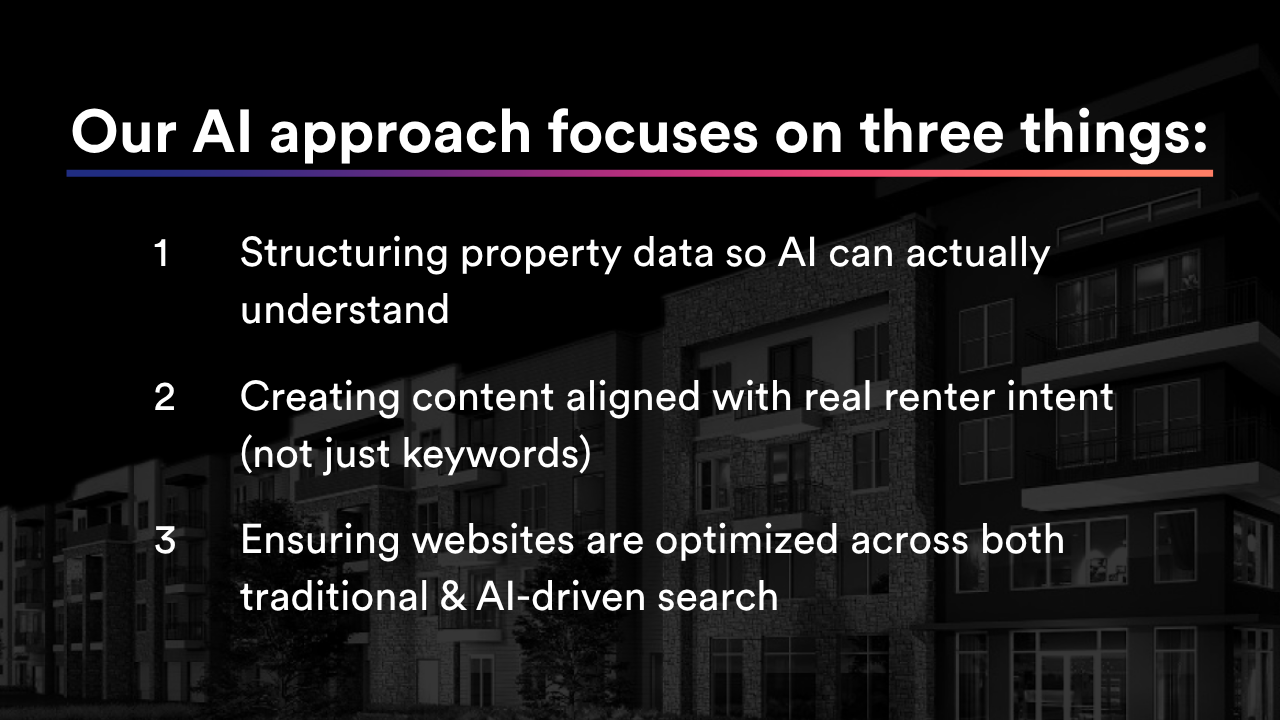
In this new landscape, ranking isn't the only goal anymore.
It's about being recognized, referenced, and recommended.
Because that's how decisions are starting to happen. AI search isn't coming; it's already here.
And platforms like Bing, Google, etc., are playing a bigger role than most realize.
Renters are asking AI where they should live.
They're comparing options before even jumping on a property site.
They're forming options earlier than ever.
Renters are already using AI to find apartments.
The question is, will your property show up when they ask?
Repli Apartment Marketing Blog
Subscribe to our Newsletter & Blogs
Blog Post Subscribe Form
Share Our Post!
Apartment Marketing Blog