Google just changed how renters find apartments. Is your property ready?
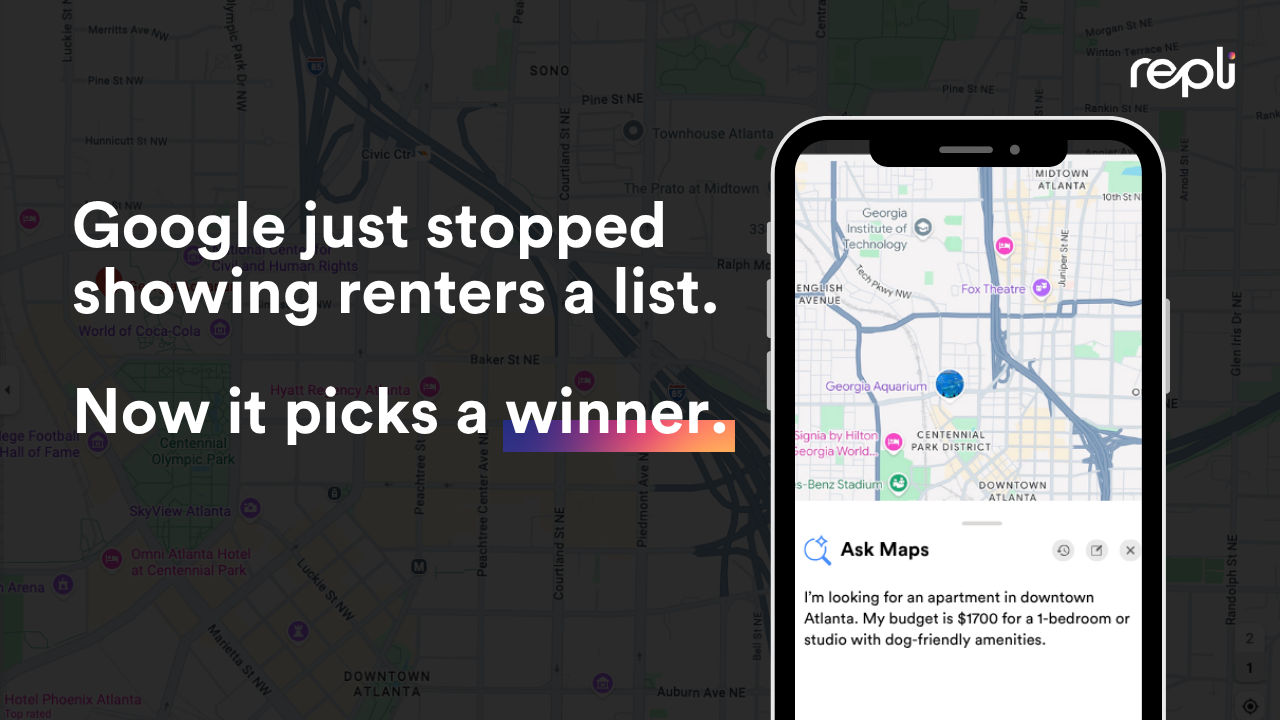
Ask Maps is live. Here's what it means for your visibility — and exactly what to do about it.
On March 12, 2026, Google quietly shipped one of the most significant changes to local search in years. It's called Ask Maps — and if you're a multifamily marketer, it changes the rules for how renters discover your community.
Instead of typing "apartments near me" and scrolling a list, renters can now open Google Maps and ask something like: "What are the best pet-friendly apartments near downtown Austin with a rooftop?" Google's Gemini AI synthesizes an answer on the spot — pulling from your Google Business Profile, your website content, and community reviews — and surfaces a curated shortlist. No links to click through. No comparison shopping. Just a direct recommendation.
That's not a small UI update. That's a fundamental shift in how discovery works. And it rewards the properties that have been doing local SEO right.
How Ask Maps actually works
Ask Maps uses four primary data sources to generate its recommendations. Understanding these is the key to knowing where to focus your energy.
Your Google Business Profile (GBP) is the most important signal. Ask Maps crawls your categories, attributes, amenities, photos, hours, and how complete your profile is. If your GBP is sparse or outdated, you're invisible before the conversation even starts.
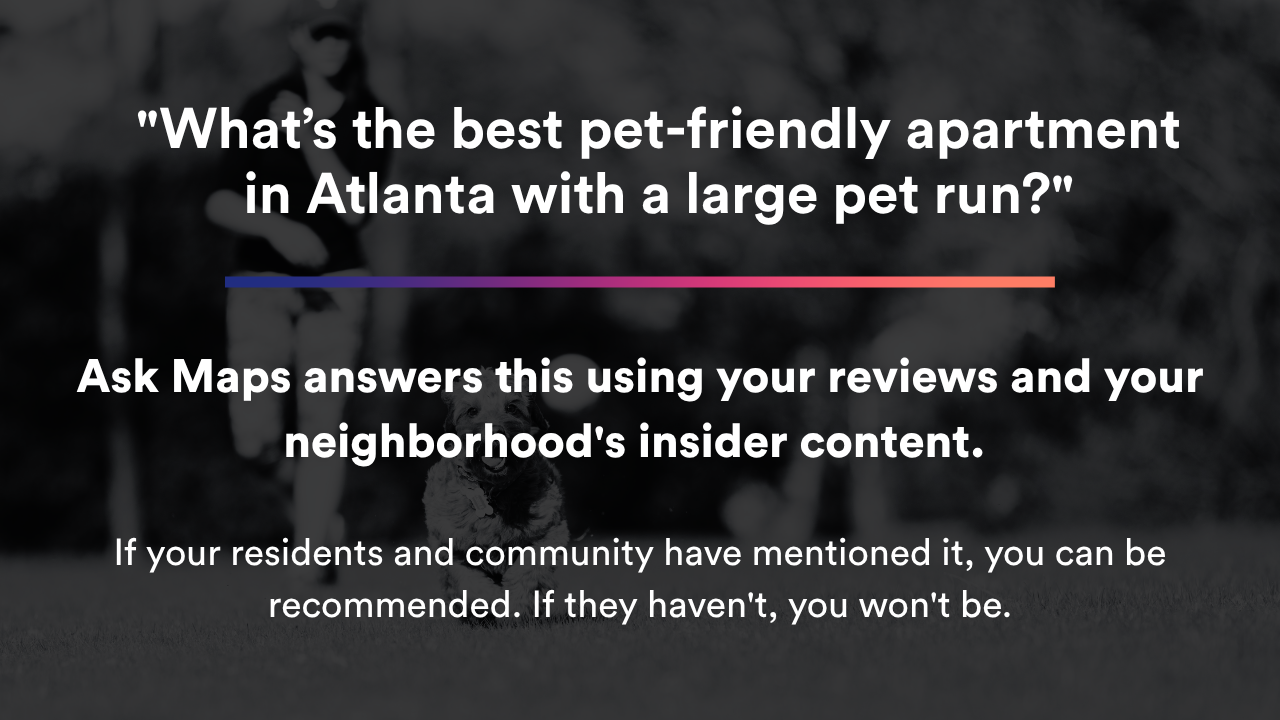
Customer reviews are the second — and increasingly critical — layer. The AI analyzes the language inside your reviews to answer specific renter questions. A review that says "great place to live" doesn't help. A review that says "the dog park is huge and well-maintained, and the staff fixed my leaking faucet within 24 hours" is gold. That's the kind of descriptive content Ask Maps can actually use to surface your property when a renter asks about pet-friendly communities or responsive maintenance.
Your website and trusted external sources form the third pillar. Ask Maps checks for consistency between what your GBP says, what your website says, and what reviewers say. Properties with thin, generic website content — or FAQ pages that don't actually answer real renter questions — get skipped.
Insider tips from real people are a fourth — and often overlooked — layer. In its official announcement, Google specifically called out that Ask Maps delivers "insider tips from real people, powered by Maps' community of contributors." This means locally contributed knowledge — neighborhood intel, hidden gems, tips about what's nearby — is actively surfaced alongside your property recommendations.
A renter asking about apartments near a walkable coffee district or a specific transit corridor isn't just seeing your listing data; they're seeing the community conversation around your neighborhood. If that conversation is rich, local, and authentic, it works in your favor. If it's thin or absent, a competitor with stronger neighborhood context wins the recommendation.
6 things you can do right now to optimize for AskMaps
1. Audit and complete your Google Business Profile
Log in to your GBP and treat it like your most important listing. Because it is. Fill in every attribute: pet policy, parking type, amenities, on-site staff, laundry, fitness center, pool, and more. Add recent, high-quality photos. Make sure your description reads like a real conversation with a prospective renter, not a brochure headline. Ask Maps prioritizes fully completed and up-to-date profiles. Anything missing is a gap a competitor can fill.
2.Upgrade how you ask for reviews — get specific
Generic review requests produce generic reviews. Instead of "Would you mind leaving us a review?", guide your residents toward the details that matter. Try something like: "We'd love it if you'd mention what you enjoy about the neighborhood, a specific amenity you use, or how our team has supported you."
Reviews that name specific features — the dog run, the proximity to the rail station, fast maintenance response — are exactly what Ask Maps uses to answer renter questions. The more descriptive your reviews, the more searchable your property becomes.
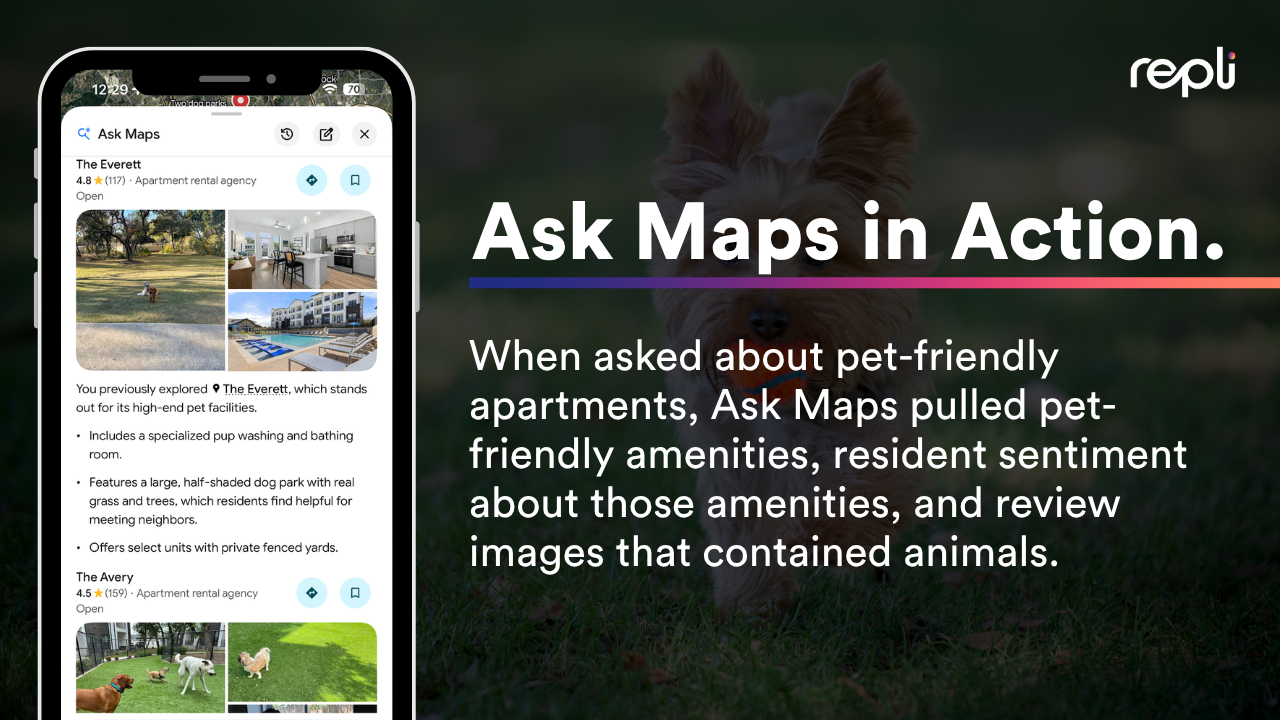
3. Respond to every review, and make your responses count
Your review responses are data, too. When you respond to a review mentioning your rooftop lounge, you're reinforcing that signal for Google's AI. Be specific in your responses — reference the amenity, the neighborhood, the feature the resident called out. Avoid boilerplate. A response that mirrors and expands on the reviewer's language helps Ask Maps build a richer understanding of what your community offers.
Bonus: it builds trust with every future renter who reads the thread.
4. Build website content that answers real renter questions
If your website has thin amenity pages or a generic "Our Location" blurb, now is the time to fix it. Ask Maps reads your site for structured, specific content. That means FAQ pages that answer questions renters actually ask ("Is the parking covered?" "How close is the nearest bus stop?").
It means location pages that connect your property to the neighborhood — nearby grocery stores, parks, transit lines, restaurants. It means amenity descriptions that go beyond a bullet list and actually tell a story. If your content reads like a brochure, rewrite it to read like a conversation.
5. Ensure your local data is consistent everywhere
Ask Maps cross-references your GBP against your website and third-party sources. Inconsistent NAP data (name, address, phone), different amenity descriptions, or conflicting information across platforms creates confusion for AI systems — and that confusion typically results in your property being deprioritized. Do a consistency audit across your GBP, website, ILS listings, and any local directories where your property appears. Align your messaging and make sure the most important attributes are stated clearly and consistently everywhere.
6. Invest in your neighborhood story. Not just your property story.
Google explicitly designed Ask Maps to surface insider tips from real community contributors alongside place recommendations. That means renters aren't just asking about your amenities — they're asking about your neighborhood. "Apartments near walkable coffee shops in Midtown." "Communities close to Piedmont Park." "Pet-friendly buildings near the best dog-friendly trails."
If your website, GBP, and hyperlocal content connect your property to the surrounding neighborhood in specific, substantive ways, Ask Maps has the material it needs to recommend you in those moments. This is where Repli's
hyperlocal dynamic pages do real work — they're built to establish your property as a genuine part of its local ecosystem, not just a pin on a map. The insider tips layer rewards properties that have invested in local context.
The bigger picture.
Ask Maps isn't an isolated feature — it's the latest signal in a clear directional shift. Google has been integrating Gemini into more and more of its surfaces, and the pattern is consistent: AI Overviews, AI Mode, and now Ask Maps all favor properties and businesses with rich, specific, consistent local content over those relying on keyword stuffing and thin pages.
Properties that invest in genuine local SEO , complete GBPs, descriptive reviews, hyperlocal website content, aren't just prepared for Ask Maps. They're building the kind of presence that earns discovery across every platform, today and the next time Google ships something new.
The question isn't whether
AI is changing how renters find apartments. It already has. The question is whether your property shows up when they ask.
Let's make sure your properties are visible.
Talk to our team about hyperlocal strategies, GBP optimization, and the content architecture that drives AI-era discovery.
Repli Apartment Marketing Blog
Subscribe to our Newsletter & Blogs
Blog Post Subscribe Form
Share Our Post!
Apartment Marketing Blog